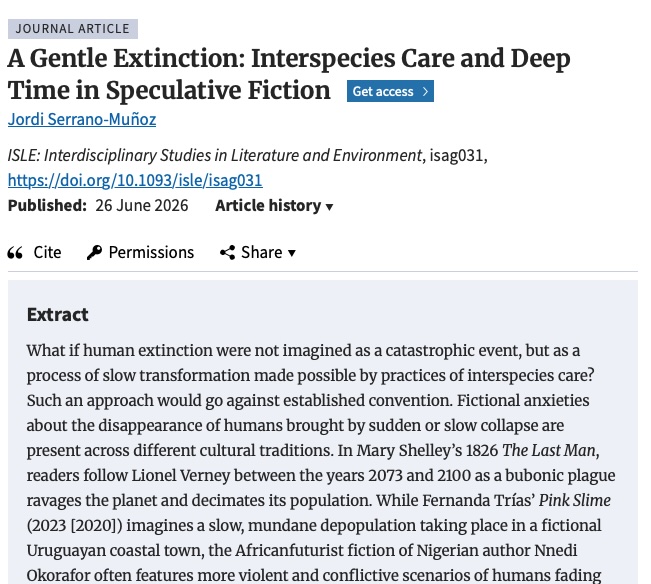
Paper: “A Gentle Extinction: Interspecies Care and Deep Time in Speculative Fiction”

My paper “A Gentle Extinction: Interspecies Care and Deep Time in Speculative Fiction” is already published in early access on ISLE‘s website!

Speculative fiction has long imagined human extinction as a disastrous collapse. This paper proposes the concept of gentle extinction, an alternative mode of imagining this scenario based on the redrawing of humanity’s boundaries as a species across time and through interspecies care. I illustrate this concept through a close reading of Kawakami Hiromi’s Under the Eye of the Big Bird (2016). I examine how formal strategies such as the dissolution of singular rupture across deep time, nonhegemonic care practices, and the polyphonic presence of nonhuman narrators create the narrative conditions for imagining human extinction beyond a catastrophic framing.

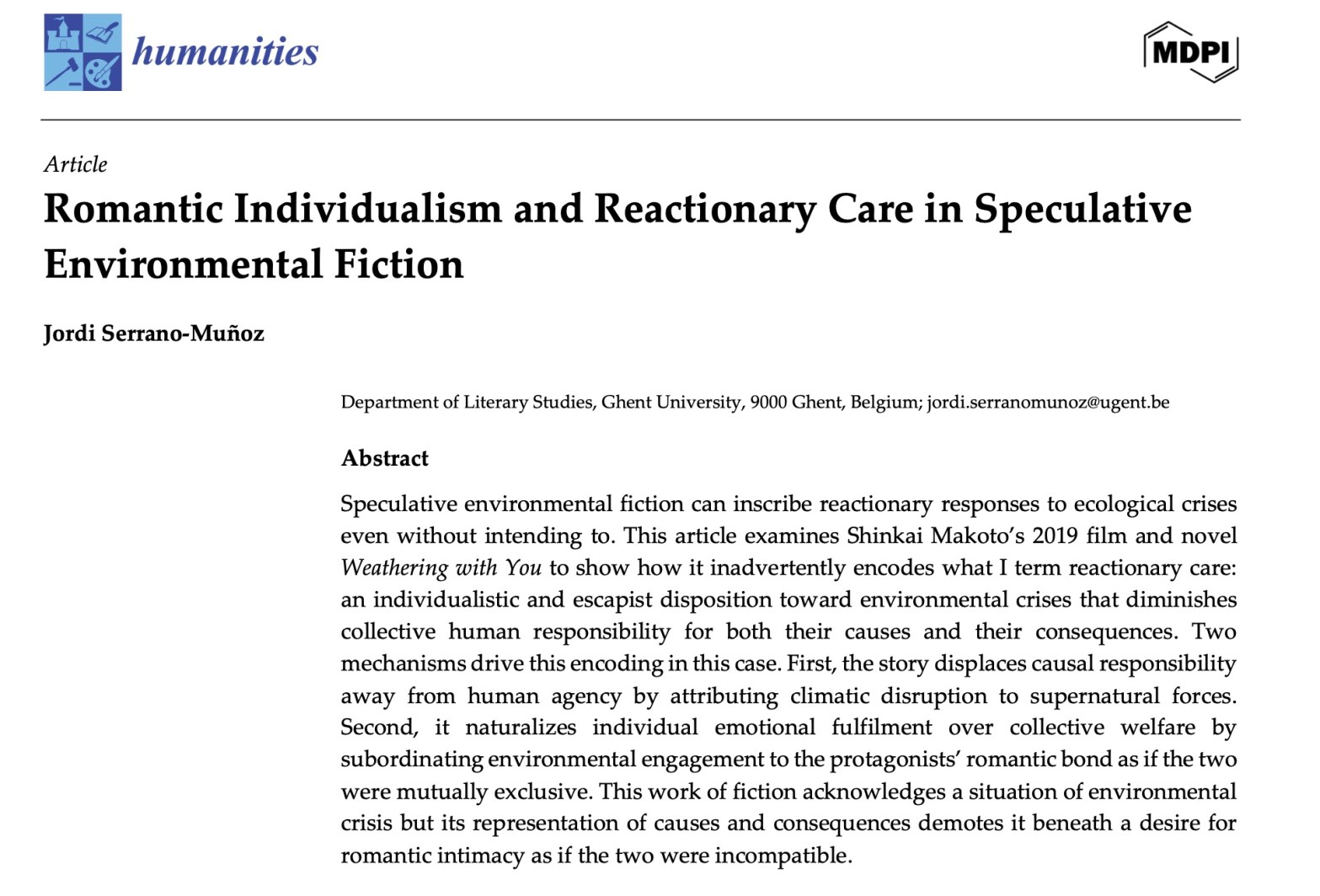
Paper: Romantic Individualism and Reactionary Care in Speculative Environmental Fiction

My paper “Romantic Individualism and Reactionary Care in Speculative Environmental Fiction“, published in the journal Humanities, is available in Open Access!

Speculative environmental fiction can inscribe reactionary responses to ecological crises even without intending to. This article examines Shinkai Makoto’s 2019 film and novel Weathering with You to show how it inadvertently encodes what I term reactionary care: an individualistic and escapist disposition toward environmental crises that diminishes collective human responsibility for both their causes and their consequences. Two mechanisms drive this encoding in this case. First, the story displaces causal responsibility away from human agency by attributing climatic disruption to supernatural forces. Second, it naturalizes individual emotional fulfilment over collective welfare by subordinating environmental engagement to the protagonists’ romantic bond as if the two were mutually exclusive. This work of fiction acknowledges a situation of environmental crisis but its representation of causes and consequences demotes it beneath a desire for romantic intimacy as if the two were incompatible.

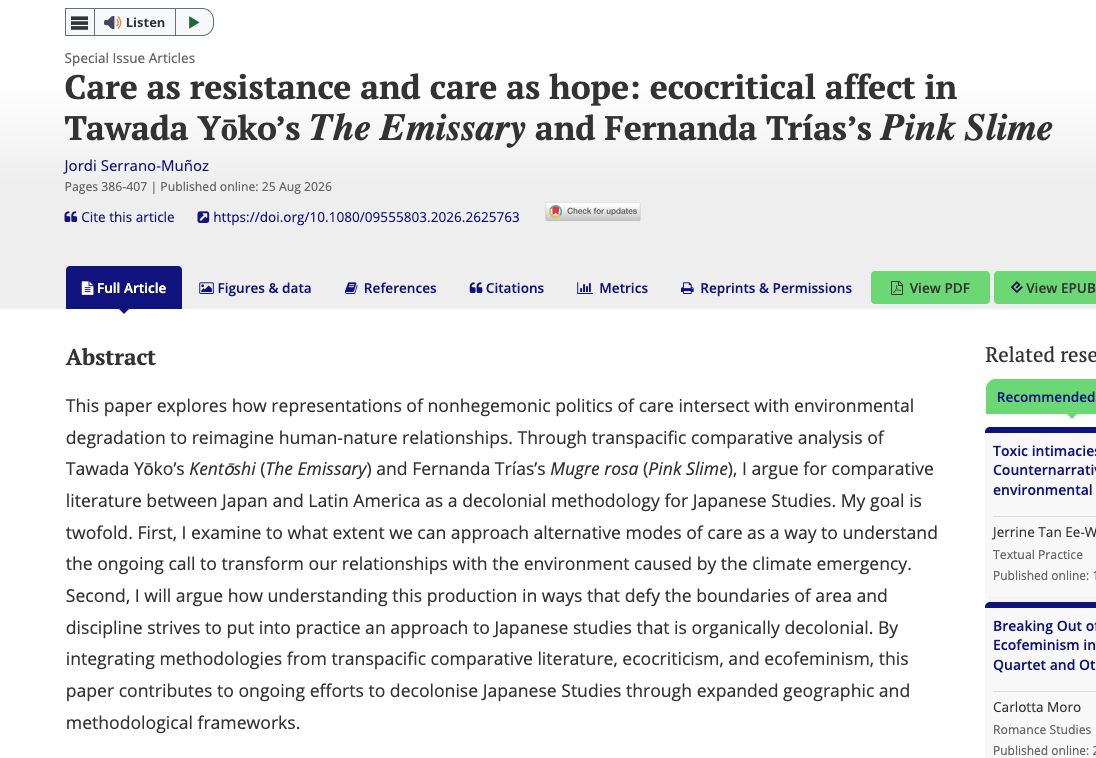
Paper: “Care as resistance and care as hope: ecocritical affect in Tawada Yōko’s The Emissary and Fernanda Trías’s Pink Slime”

I am happy to announce that my paper “Care as resistance and care as hope: ecocritical affect in Tawada Yōko’s The Emissary and Fernanda Trías’s Pink Slime“, published in Japan Forum’s special issue on decolonising Japanese fictions, is available:

This paper explores how representations of nonhegemonic politics of care intersect with environmental degradation to reimagine human-nature relationships. Through transpacific comparative analysis of Tawada Yōko’s Kentōshi (The Emissary) and Fernanda Trías’s Mugre rosa (Pink Slime), I argue for comparative literature between Japan and Latin America as a decolonial methodology for Japanese Studies. My goal is twofold. First, I examine to what extent we can approach alternative modes of care as a way to understand the ongoing call to transform our relationships with the environment caused by the climate emergency. Second, I will argue how understanding this production in ways that defy the boundaries of area and discipline strives to put into practice an approach to Japanese studies that is organically decolonial. By integrating methodologies from transpacific comparative literature, ecocriticism, and ecofeminism, this paper contributes to ongoing efforts to decolonise Japanese Studies through expanded geographic and methodological frameworks.

Disasters Maybe Podcast is Out!

I’m excited to share Disasters Maybe, the podcast about disaster imagination in contemporary fiction that is a companion to the Disaster Distortion project, is out!

Six episodes, thirty minutes each, in which I talk with scholars and writers about what imagining catastrophes can and cannot do for our understanding of the crises we are living through. The conversations cover AI and disaster narratives with Marco Caracciolo, solarpunk and awe with Ciarán Kavanagh, young adult climate fiction and eco-anxiety with Chiara Xausa, the emotional geography of climate collapse with Andrea Chapela, and neurodivergence and resilience with Rose Michael.

There’s also a solo introductory episode where I lay out the broader argument about why fiction’s obsession with spectacular disaster might be obscuring part of the experience of living through the climate crisis.

Available on:

– Spotify as audio only
– Apple Podcasts as audio only
– YouTube as video and audio

Spring activities 2026

This has also been a very active spring, which has been dominated by different conference papers that have been a nice distraction from the multiple writing commitments, mostly the ongoing monograph.

In late February I presented a paper on Kawakami Hiromi’s Under the Eye of the Big Bird for the Queer Ecologies and the Temporal Imagination conference held in Tübingen. I was so hooked on my reading of this work that I took the chance to expand on it and turned it into a paper that got published in ISLE as “A Gentle Extinction: Interspecies Care and Deep Time in Speculative Fiction.”

On April, I organized a panel with colleagues Shannon Lambert, Chiara Xausa, and Gabriele D’Amato on the literary representations of extractivism for the 1th Biennial EASLCE Conference held in Utrecht under the unforgivable name of ‘Join the Orca Uprising!’. In my paper, I read Robbie Arnott’s The Rain Heron for how it represents nonhuman agency as an equalizer to human characters without focalization; it also got turned into a paper that is currently being under review.

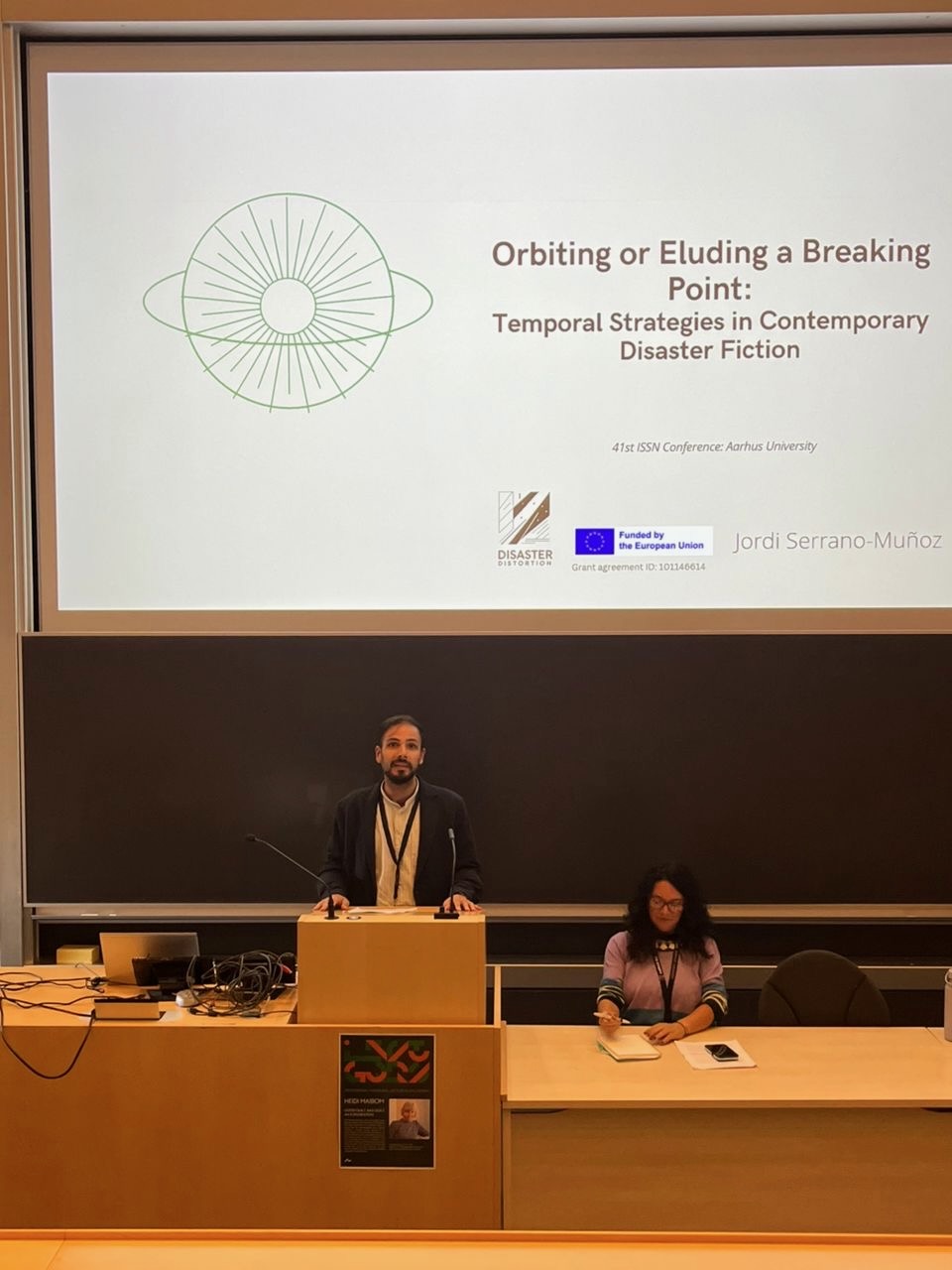
On June, I finally joined the hype of the Narrative conference by attending the 41st ISSN gathering in Aarhus, where I gave a paper titled “Orbiting or Eluding a Breaking Point: Temporal Strategies in Contemporary Disaster Fiction,” derived from chapter 2 on my Disaster Distortion monograph in the making. Had plenty of fun moving between panels but especially dancing to Bad Bunny at the closing dance!

And finally, right on the cusp of the summer solstice, I went back to Pompeu Fabra University to present an invited paper for the symposium “Rethinking Population Ageing: Multidisciplinary Disciplines,” organized by Stefano Bellin (thank you for the invitation!) and where I could meet friends and colleagues.

Melbourne research stay

The third and last research stay of the year, the one that closed the circle opened in February in Mexico and followed in June in Tokyo, brought me to Melbourne at the invitation of Debjani Ganguly and Killian Quigley from the Institute of Humanities at ACU. I spent the month of October happily shifting between endless coffee dates with researchers at the Institute and at the University of Melbourne, doing book hunting, getting elbows-deep in writing, and walking around the now quite dear areas of Fitzroy, Collingwood, and the solace of the Yarra river.

There was time too to add a short trip to Sydney to attend Marco Caracciolo’s lecture at the University of New South Wales on Weird Ecologies in Literature and Video Game Narratives. We enjoyed the hospitality of Paul Dawson, Sean Pryor, Xanthe Muston, and Shaye Easton, among other friends and colleagues. There was even time to make some sightseeing across the coast, bracing the strong spring winds.

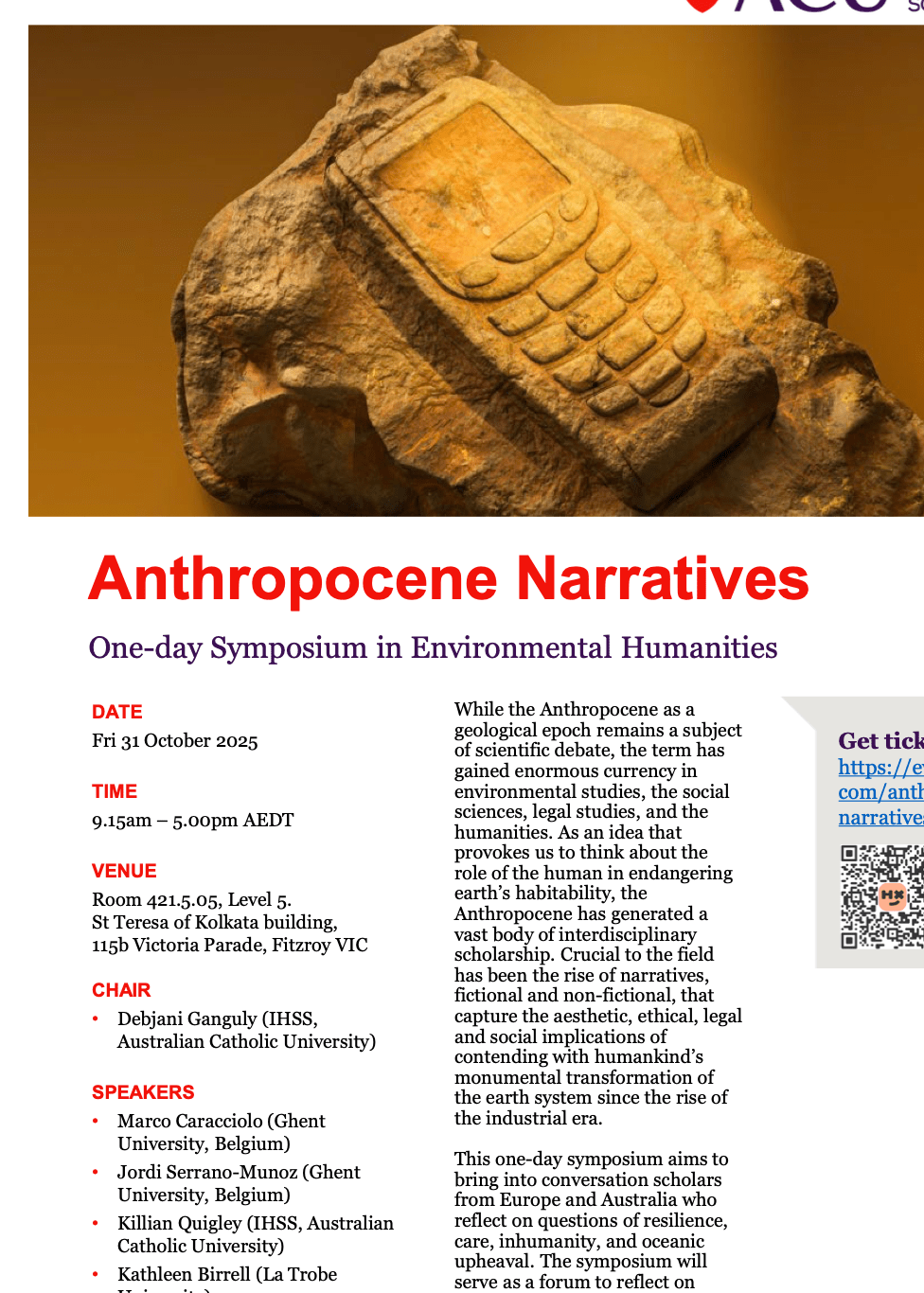
The stay had its climatic peak with a full-day event at ACU on Anthropocene Narratives. Together with the wonderful presentations by Marco, Killian, and Kathleen Birrell, and expertly chaired by Debjani, we discussed questions of time, materiality, action, and the convergence of human and nonhuman interests in narrative. I thank the opportunity also of sharing my ongoing work on the thematic and formal narrative conditions of disaster distortion as it applies to the imagination of care, which has been my main theoretical development during this stay.

Summer activities 2025

This has been a very prolific and exciting summer, which started at the end of Spring and has been filled with different public activities: workshops, conferences, and symposia.

As mentioned in the previous post, in May I joined Chiara Xausa and Marco Caracciolo for a workshop at Ghent University on ecofeminism, as part of the wonderful ongoing series of ecocritical reading sessions organized by Shannon Lambert and Leila Williamson. I talked about reactionary care in Makoto Shinkai’s Weathering with you – a paper will come out soon if all goes well!

Later on, I participated in the TRAMEVIC symposium, organized at the University of Valencia by Marcos Centeno, on visual representations of transnational memories, specifically in a session on the redefinition of perpetrators, with a paper on the greenwashing and whitewashing of Japan’s wartime responsibility in Godzilla Minus One.

June was devoted to a research visit to Japan. It started with my attendance at the Japan Past and Present conference on the reimagination of the field of Japanese studies, held at my dear temporary alma mater, University of Waseda. I then took the chance to stay longer in Tokyo and gather material, resources, meet with friends and colleagues, and buy books, many books. I was also invited by UGent’s EU-team to give a talk to prospective MSCA candidates, providing advice on what could they do to enhance their chances of succes.

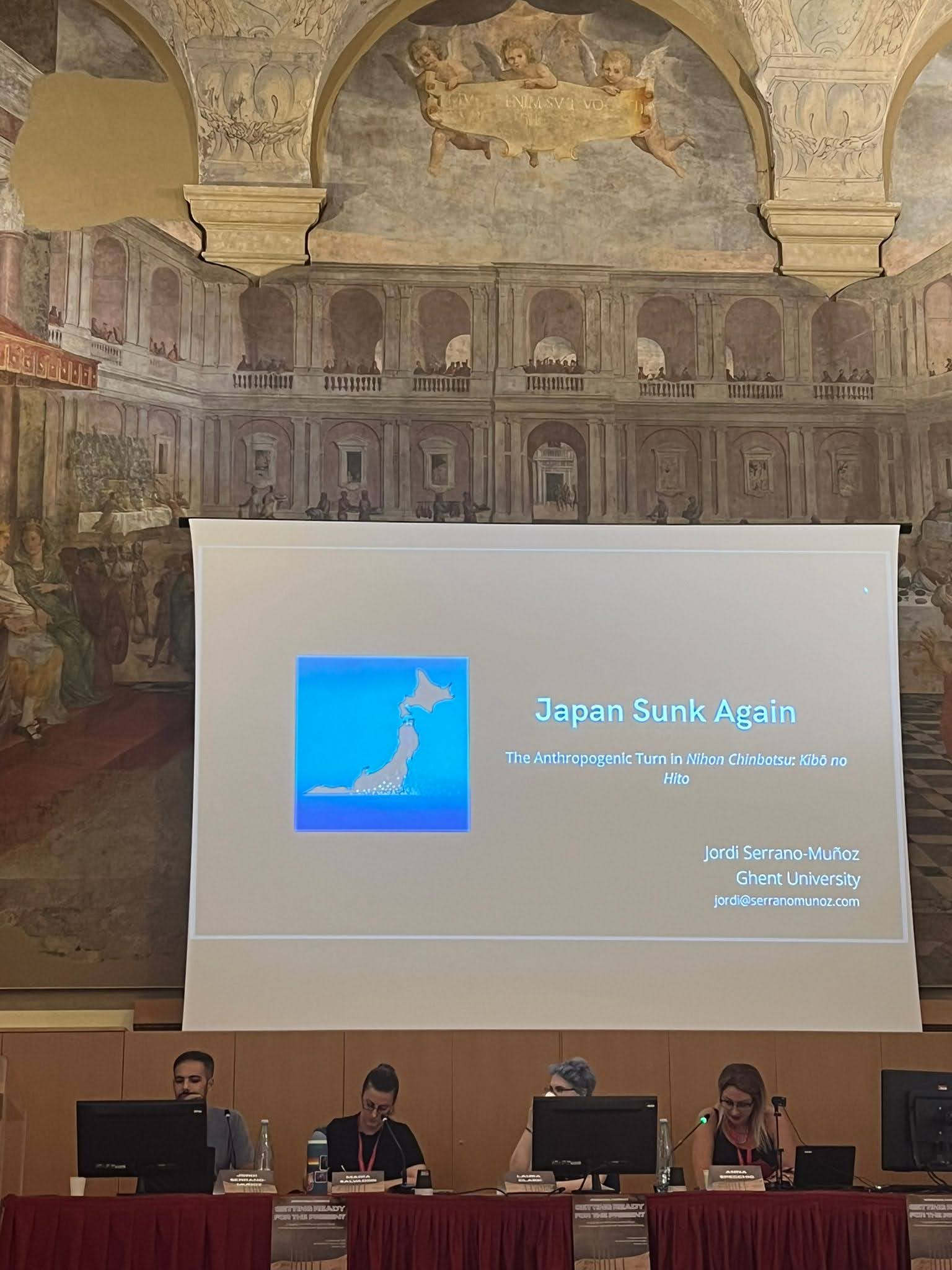
Finally, I am happy to have participated in the conference “Getting Ready for the Present: Engaging with the World and the Planet in Contemporary Dystopian and Speculative Narratives”, organized at the University of Bologna, at the stunning San Giovanni in Monte complex. I presented a paper on the Anthropogenic turn as traced by analyzing the adaptation of Komatsu Sakyo’s seminal Japan Sinks in Japan Sinks: People of Hope. I don’t think I have ever had a better background for these kinds of talks! My sincere gratitude to the organizers, the team led by prof. Paola Scrolavezza.
Editor for the Special Issue Cli-Fi as Dystopia, Utopia, or Realism, in Theory Now

I am thrilled to announce that the special issue I have edited for Theory Now called “Cli-Fi as Dystopia, Utopia, or Realism: Understanding the Challenges of Imagining the Climate Crisis” is now available to read in full open access through their website!

In this issue, you will find very exciting works from a diverse range of authors, featuring particularly scholars working in or from East Asia and Latin America.

I have also authored an introductory piece and a conversation with Marco Caracciolo, who also has a paper in this issue on eco-anxiety.

Thank you to the editors of Theory Now for their excellent work coordinating this issue and to all the authors. Happy reading!

Ecofeminist panel at Ghent University Spring 2025

Springtime 2025 in Ghent has been marked by a lot of emphasis on setting up the analytical framework of the project, testing the methodological setup of thematic comparative analysis through empirical stress-testing and some valuable help from my colleagues at the department, and preparing some texts on these initial outcomes, hopefully to be published once they go through the necessary stages of internal (and external) review.

I also had the wonderful chance to discuss questions on ecofeminist analysis of literary works together with my colleagues Marco Caracciolo and Chiara Xausa in a panel organized by Shannon Lambert and Leila Wilson as part of their fantastic ongoing working group on ecocriticism. While Marco discussed matters on care and queering for the nonhuman and Chiara did a wonderful job in laying out the grounds and definitions of the discipline through her case studies, I decided to talk about how ecofeminist concerns can emerge also as a way to reveal reactionary motives in works that otherwise would have been overlooked. I used the case of Tenki no ko, or Weathering with you, by Makoto Shinkai, to show how the romantic love relationship that structures this disaster narrative can be seen as reactionary when read through an ecofeminist lens.

A written version of these arguments will – hopefully – be available soon in publication.

Research stay in Mexico Winter 2025

Going back to Mexico, at this point, is always a treat. Not only did I have the chance of seeing old friends and acquaintances, walking the lovely yet unevenly paved streets, and struggle against my role in the gentrification of the city, but also it was a wonderful and productive experience for my project. I socialized my ideas, received interesting feedback, and came back with new books in my suitcase.

I had a chance of discussing during a graduate workshop the spaces of connection and tension between discourses of modernization and the role of disasters in Japan during the first half of the twentieth century, creating parallels with the function catastrophes have had for Mexico.

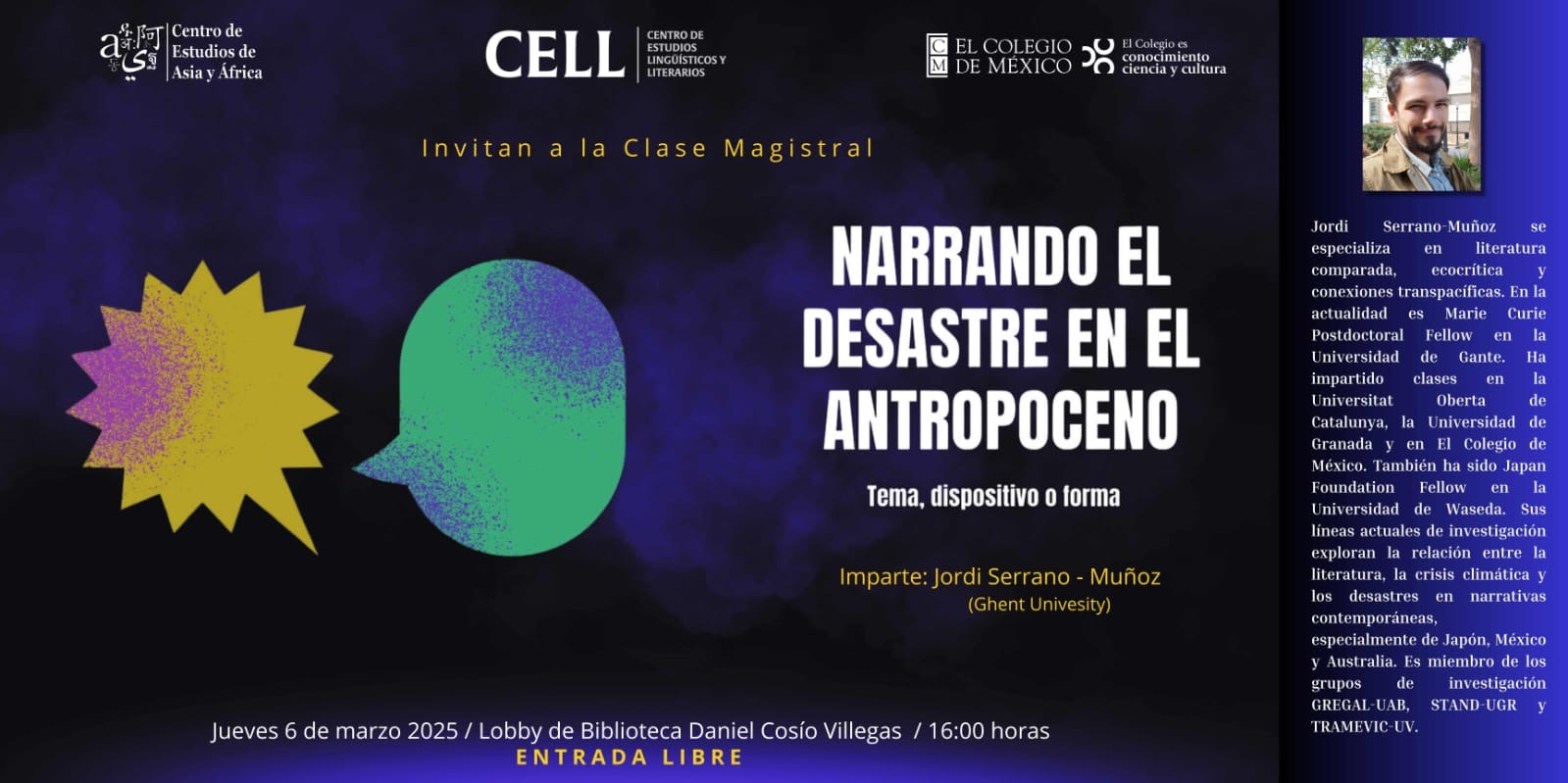
More importantly, I was invited to conduct a master class on Disaster Narratives in the Anthropocene, which was a fantastic opportunity to put to a test my current work and bring home interesting thought-provoking comments from the very active audience.

My special thanks too to professor Matías Chiappe for extending the invitation to work with you and the rest of our colleagues at El Colegio de México and for acting as a gracious host throughout my stay.