Paper: “A Gentle Extinction: Interspecies Care and Deep Time in Speculative Fiction”

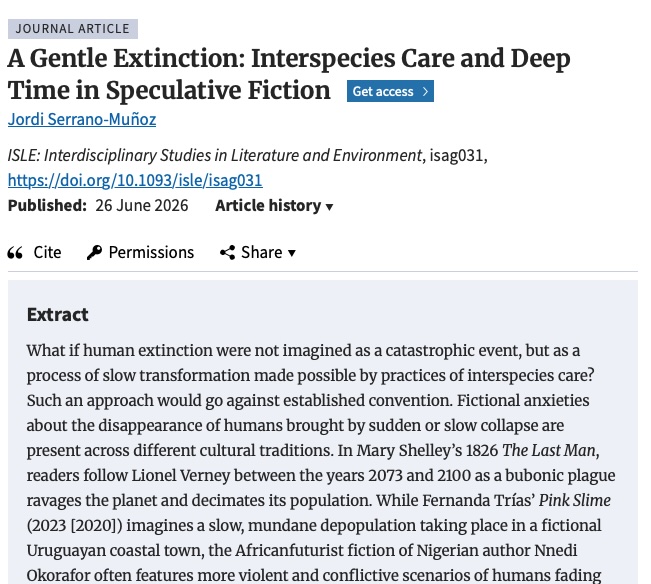
My paper “A Gentle Extinction: Interspecies Care and Deep Time in Speculative Fiction” is already published in early access on ISLE‘s website!

Speculative fiction has long imagined human extinction as a disastrous collapse. This paper proposes the concept of gentle extinction, an alternative mode of imagining this scenario based on the redrawing of humanity’s boundaries as a species across time and through interspecies care. I illustrate this concept through a close reading of Kawakami Hiromi’s Under the Eye of the Big Bird (2016). I examine how formal strategies such as the dissolution of singular rupture across deep time, nonhegemonic care practices, and the polyphonic presence of nonhuman narrators create the narrative conditions for imagining human extinction beyond a catastrophic framing.

Paper: Romantic Individualism and Reactionary Care in Speculative Environmental Fiction

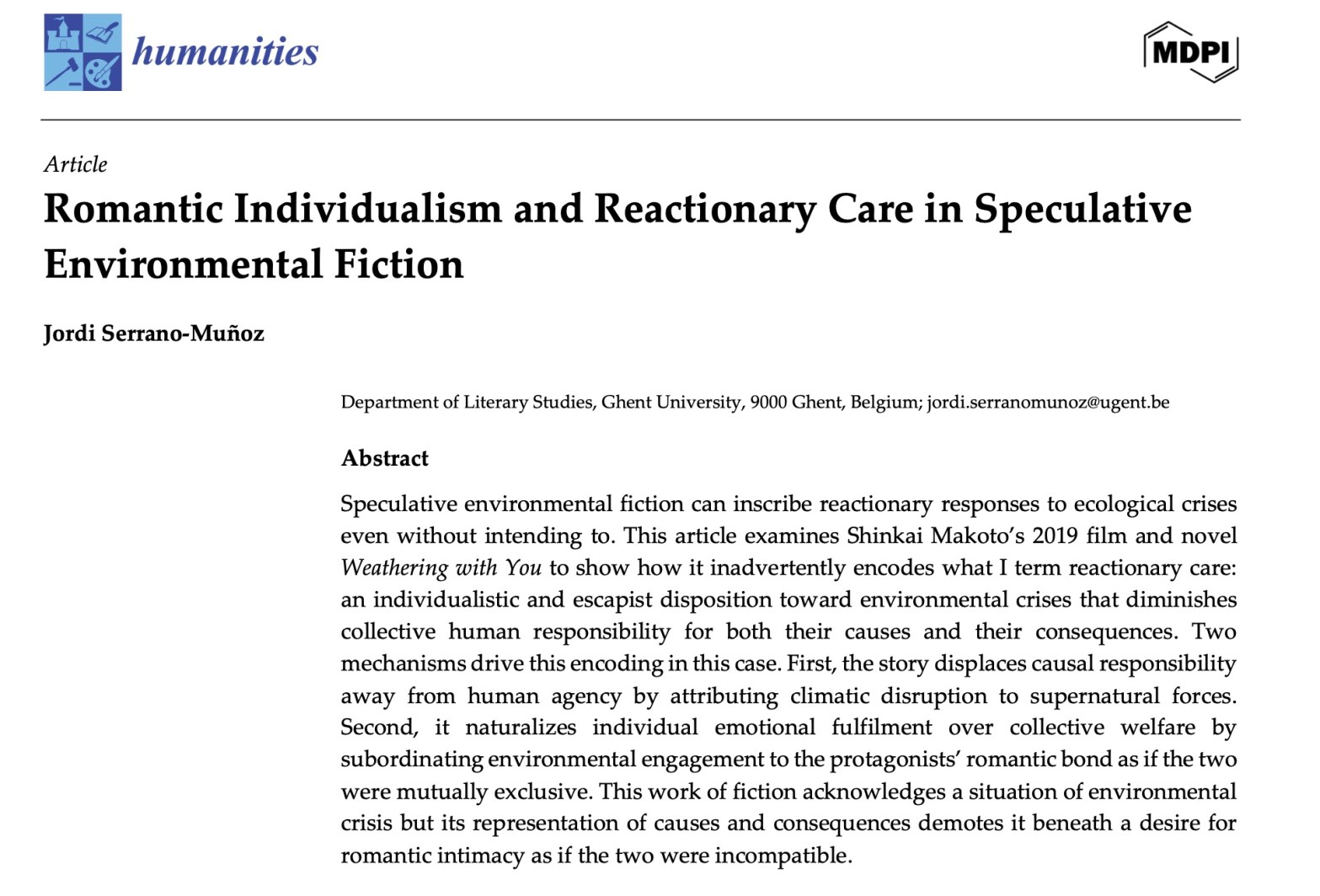
My paper “Romantic Individualism and Reactionary Care in Speculative Environmental Fiction“, published in the journal Humanities, is available in Open Access!

Speculative environmental fiction can inscribe reactionary responses to ecological crises even without intending to. This article examines Shinkai Makoto’s 2019 film and novel Weathering with You to show how it inadvertently encodes what I term reactionary care: an individualistic and escapist disposition toward environmental crises that diminishes collective human responsibility for both their causes and their consequences. Two mechanisms drive this encoding in this case. First, the story displaces causal responsibility away from human agency by attributing climatic disruption to supernatural forces. Second, it naturalizes individual emotional fulfilment over collective welfare by subordinating environmental engagement to the protagonists’ romantic bond as if the two were mutually exclusive. This work of fiction acknowledges a situation of environmental crisis but its representation of causes and consequences demotes it beneath a desire for romantic intimacy as if the two were incompatible.

Paper: “Care as resistance and care as hope: ecocritical affect in Tawada Yōko’s The Emissary and Fernanda Trías’s Pink Slime”

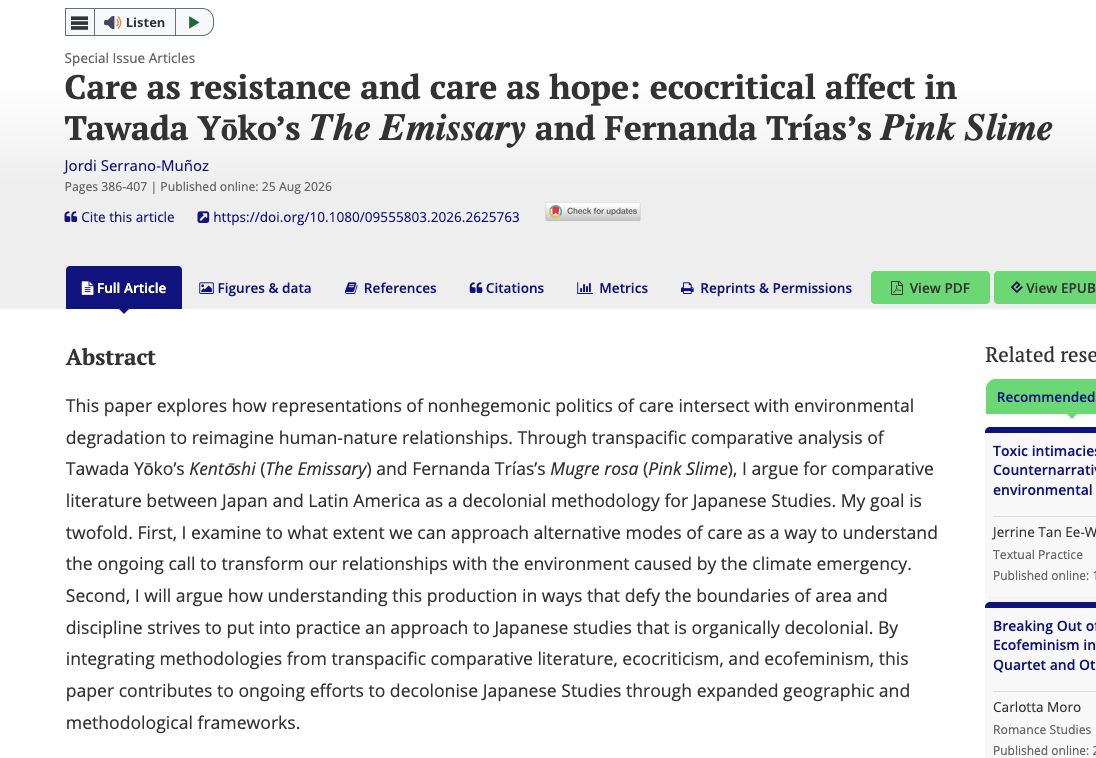
I am happy to announce that my paper “Care as resistance and care as hope: ecocritical affect in Tawada Yōko’s The Emissary and Fernanda Trías’s Pink Slime“, published in Japan Forum’s special issue on decolonising Japanese fictions, is available:

This paper explores how representations of nonhegemonic politics of care intersect with environmental degradation to reimagine human-nature relationships. Through transpacific comparative analysis of Tawada Yōko’s Kentōshi (The Emissary) and Fernanda Trías’s Mugre rosa (Pink Slime), I argue for comparative literature between Japan and Latin America as a decolonial methodology for Japanese Studies. My goal is twofold. First, I examine to what extent we can approach alternative modes of care as a way to understand the ongoing call to transform our relationships with the environment caused by the climate emergency. Second, I will argue how understanding this production in ways that defy the boundaries of area and discipline strives to put into practice an approach to Japanese studies that is organically decolonial. By integrating methodologies from transpacific comparative literature, ecocriticism, and ecofeminism, this paper contributes to ongoing efforts to decolonise Japanese Studies through expanded geographic and methodological frameworks.

Disasters Maybe Podcast is Out!

I’m excited to share Disasters Maybe, the podcast about disaster imagination in contemporary fiction that is a companion to the Disaster Distortion project, is out!

Six episodes, thirty minutes each, in which I talk with scholars and writers about what imagining catastrophes can and cannot do for our understanding of the crises we are living through. The conversations cover AI and disaster narratives with Marco Caracciolo, solarpunk and awe with Ciarán Kavanagh, young adult climate fiction and eco-anxiety with Chiara Xausa, the emotional geography of climate collapse with Andrea Chapela, and neurodivergence and resilience with Rose Michael.

There’s also a solo introductory episode where I lay out the broader argument about why fiction’s obsession with spectacular disaster might be obscuring part of the experience of living through the climate crisis.

Available on:

– Spotify as audio only
– Apple Podcasts as audio only
– YouTube as video and audio

Editor for the Special Issue Cli-Fi as Dystopia, Utopia, or Realism, in Theory Now

I am thrilled to announce that the special issue I have edited for Theory Now called “Cli-Fi as Dystopia, Utopia, or Realism: Understanding the Challenges of Imagining the Climate Crisis” is now available to read in full open access through their website!

In this issue, you will find very exciting works from a diverse range of authors, featuring particularly scholars working in or from East Asia and Latin America.

I have also authored an introductory piece and a conversation with Marco Caracciolo, who also has a paper in this issue on eco-anxiety.

Thank you to the editors of Theory Now for their excellent work coordinating this issue and to all the authors. Happy reading!

CfP Theory Now: Cli-Fi as Dystopia, Utopia, or Realism: Understanding the Challenges of Imagining the Climate Crisis

I am editing a special issue on Cli-Fi for the journal Theory Now, to be published in summer 2025. Here are the details:

Submissions until December 1, 2024. Please ensure that submissions are sent to the guest editor (jordi@serranomunoz.com) and uploaded simultaneously to the platform.

In a time when the specter of environmental catastrophe is not a possibility for a hypothetical or distant future, but a matter of contemporary and most pressing concern, the ways in which we incorporate its causes and consequences into our collective cultural imagination as a species has emerged as a dynamic arena for critical inquiry. As scientists, scholars, and policy-makers grapple with the complexities of how to effectively address the climate crisis, contemporary fiction has become a site for exploring another set of parallel questions: how are we imagining a present and a future where climate crisis is the new norm? When do we cross the threshold of considering the ongoing climate crisis a matter of realist fiction instead of a concern for authors of dystopian plots? Is it still possible – or even responsible – to imagine eco-utopias based on how far behind are we on our goals for sustainable development? Or are they now more necessary than ever to promote an ideal objective to achieve?

Building upon existing scholarship, this special issue of Theory Now aims to deepen our understanding of climate fiction (cli-fi) and to question the range and diversity of its manifestations. From the stark realism of cli-fi dystopias to techno-optimism, authors employ a diverse array of narrative techniques to confront the existential challenges posed by the climate crisis. We encourage authors to analyze the intricate interplay of form and content, exploring how fiction shapes our understanding of the climate crisis and inspire transformative action. As our definition of what to consider cli-fi continues to evolve as a genre, questions surrounding its boundaries, conventions, and aesthetic sensibilities have come to the fore.

While much attention has been paid to cli-fi produced in Europe and the United States, voices from the Global South offer invaluable perspectives on the climate crisis, challenging dominant narratives and foregrounding the intersecting dynamics of race, class, and colonial legacies. We encourage papers addressing these questions and which explore the diverse voices and narratives emanating from underrepresented connections and traditions.

We welcome submissions from scholars across disciplines, including literature, cultural studies, environmental humanities, and beyond. Interdisciplinary approaches are encouraged, as are contributions that engage with underrepresented voices and perspectives. An example of potential topics includes, but is not limited to:

  • Discussion on the state and direction of speculative fiction, either utopias or dystopias, when it comes to the representation of the climate crisis.
  • Debates over how tropes associated with cli-fi intertwined with conventions traditionally associated with realism in literary fiction.
  • Contemporary fictional representations of the climate crisis, specially by authors from the Global South.
  • The role and presence of counter-hegemonic politics of care and ecofeminism in contemporary climate fiction.
  • Challenges for the narration of the climate crisis, such as questions on temporality, spatial distribution, regional inequality, individual vs collective agency, or human-nonhuman relationships.
  • Transmedia and transdiciplinary approaches to the representation of the climate crisis, with an emphasis on the challenges and opportunities brought by bending traditional conventional lines.

Papers should be between 5,000 to 11,000 words, including notes and references. They need to follow the journal’s style of conventions and can be written in English, Spanish, or French. Authors are responsible for any necessary language editing and proofing. Submissions must include a justification on why the author believes their paper fits within the scope of this special issue.