Melbourne research stay

The third and last research stay of the year, the one that closed the circle opened in February in Mexico and followed in June in Tokyo, brought me to Melbourne at the invitation of Debjani Ganguly and Killian Quigley from the Institute of Humanities at ACU. I spent the month of October happily shifting between endless coffee dates with researchers at the Institute and at the University of Melbourne, doing book hunting, getting elbows-deep in writing, and walking around the now quite dear areas of Fitzroy, Collingwood, and the solace of the Yarra river.

There was time too to add a short trip to Sydney to attend Marco Caracciolo’s lecture at the University of New South Wales on Weird Ecologies in Literature and Video Game Narratives. We enjoyed the hospitality of Paul Dawson, Sean Pryor, Xanthe Muston, and Shaye Easton, among other friends and colleagues. There was even time to make some sightseeing across the coast, bracing the strong spring winds.

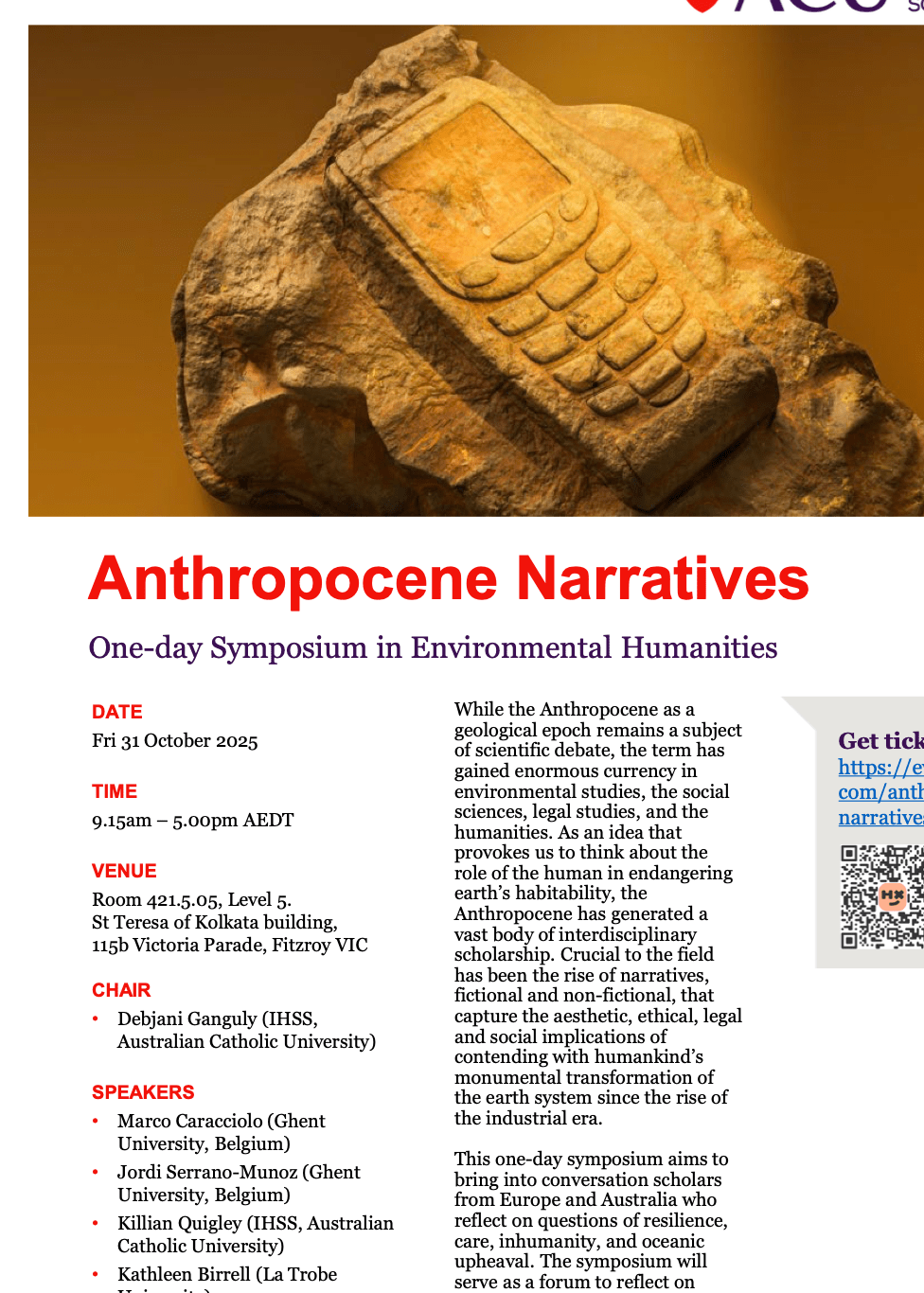
The stay had its climatic peak with a full-day event at ACU on Anthropocene Narratives. Together with the wonderful presentations by Marco, Killian, and Kathleen Birrell, and expertly chaired by Debjani, we discussed questions of time, materiality, action, and the convergence of human and nonhuman interests in narrative. I thank the opportunity also of sharing my ongoing work on the thematic and formal narrative conditions of disaster distortion as it applies to the imagination of care, which has been my main theoretical development during this stay.

Summer activities 2025

This has been a very prolific and exciting summer, which started at the end of Spring and has been filled with different public activities: workshops, conferences, and symposia.

As mentioned in the previous post, in May I joined Chiara Xausa and Marco Caracciolo for a workshop at Ghent University on ecofeminism, as part of the wonderful ongoing series of ecocritical reading sessions organized by Shannon Lambert and Leila Williamson. I talked about reactionary care in Makoto Shinkai’s Weathering with you – a paper will come out soon if all goes well!

Later on, I participated in the TRAMEVIC symposium, organized at the University of Valencia by Marcos Centeno, on visual representations of transnational memories, specifically in a session on the redefinition of perpetrators, with a paper on the greenwashing and whitewashing of Japan’s wartime responsibility in Godzilla Minus One.

June was devoted to a research visit to Japan. It started with my attendance at the Japan Past and Present conference on the reimagination of the field of Japanese studies, held at my dear temporary alma mater, University of Waseda. I then took the chance to stay longer in Tokyo and gather material, resources, meet with friends and colleagues, and buy books, many books. I was also invited by UGent’s EU-team to give a talk to prospective MSCA candidates, providing advice on what could they do to enhance their chances of succes.

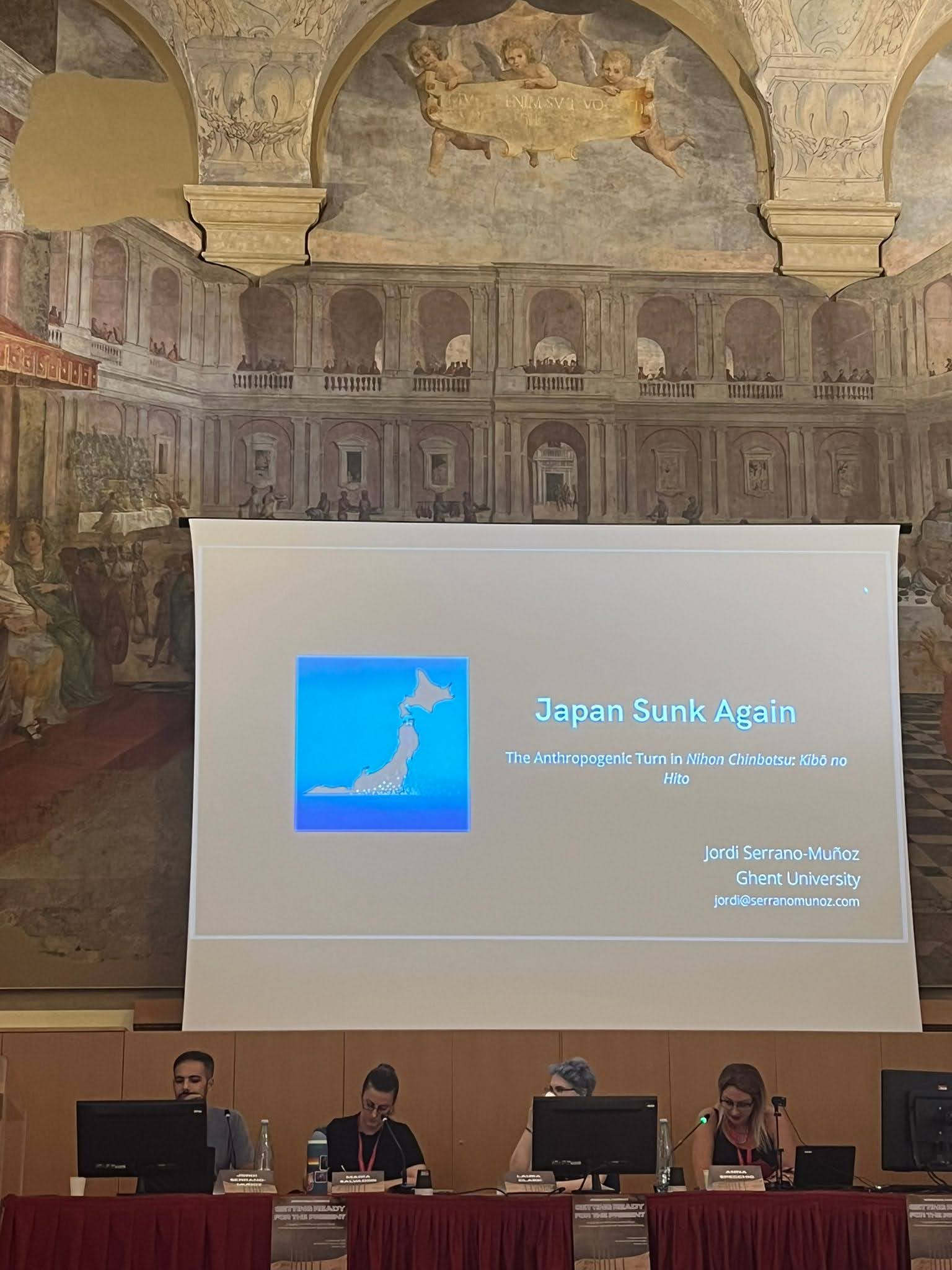
Finally, I am happy to have participated in the conference “Getting Ready for the Present: Engaging with the World and the Planet in Contemporary Dystopian and Speculative Narratives”, organized at the University of Bologna, at the stunning San Giovanni in Monte complex. I presented a paper on the Anthropogenic turn as traced by analyzing the adaptation of Komatsu Sakyo’s seminal Japan Sinks in Japan Sinks: People of Hope. I don’t think I have ever had a better background for these kinds of talks! My sincere gratitude to the organizers, the team led by prof. Paola Scrolavezza.

New Publication! Editor for the Special Issue Cli-Fi as Dystopia, Utopia, or Realism, in Theory Now

I am thrilled to announce that the special issue I have edited for Theory Now called “Cli-Fi as Dystopia, Utopia, or Realism: Understanding the Challenges of Imagining the Climate Crisis” is now available to read in full open access through their website!

In this issue, you will find very exciting works from a diverse range of authors, featuring particularly scholars working in or from East Asia and Latin America.

I have also authored an introductory piece and a conversation with Marco Caracciolo, who also has a paper in this issue on eco-anxiety.

Thank you to the editors of Theory Now for their excellent work coordinating this issue and to all the authors. Happy reading!

Ecofeminist panel at Ghent University Spring 2025

Springtime 2025 in Ghent has been marked by a lot of emphasis on setting up the analytical framework of the project, testing the methodological setup of thematic comparative analysis through empirical stress-testing and some valuable help from my colleagues at the department, and preparing some texts on these initial outcomes, hopefully to be published once they go through the necessary stages of internal (and external) review.

I also had the wonderful chance to discuss questions on ecofeminist analysis of literary works together with my colleagues Marco Caracciolo and Chiara Xausa in a panel organized by Shannon Lambert and Leila Wilson as part of their fantastic ongoing working group on ecocriticism. While Marco discussed matters on care and queering for the nonhuman and Chiara did a wonderful job in laying out the grounds and definitions of the discipline through her case studies, I decided to talk about how ecofeminist concerns can emerge also as a way to reveal reactionary motives in works that otherwise would have been overlooked. I used the case of Tenki no ko, or Weathering with you, by Makoto Shinkai, to show how the romantic love relationship that structures this disaster narrative can be seen as reactionary when read through an ecofeminist lens.

A written version of these arguments will – hopefully – be available soon in publication.

Research stay in Mexico Winter 2025

Going back to Mexico, at this point, is always a treat. Not only did I have the chance of seeing old friends and acquaintances, walking the lovely yet unevenly paved streets, and struggle against my role in the gentrification of the city, but also it was a wonderful and productive experience for my project. I socialized my ideas, received interesting feedback, and came back with new books in my suitcase.

I had a chance of discussing during a graduate workshop the spaces of connection and tension between discourses of modernization and the role of disasters in Japan during the first half of the twentieth century, creating parallels with the function catastrophes have had for Mexico.

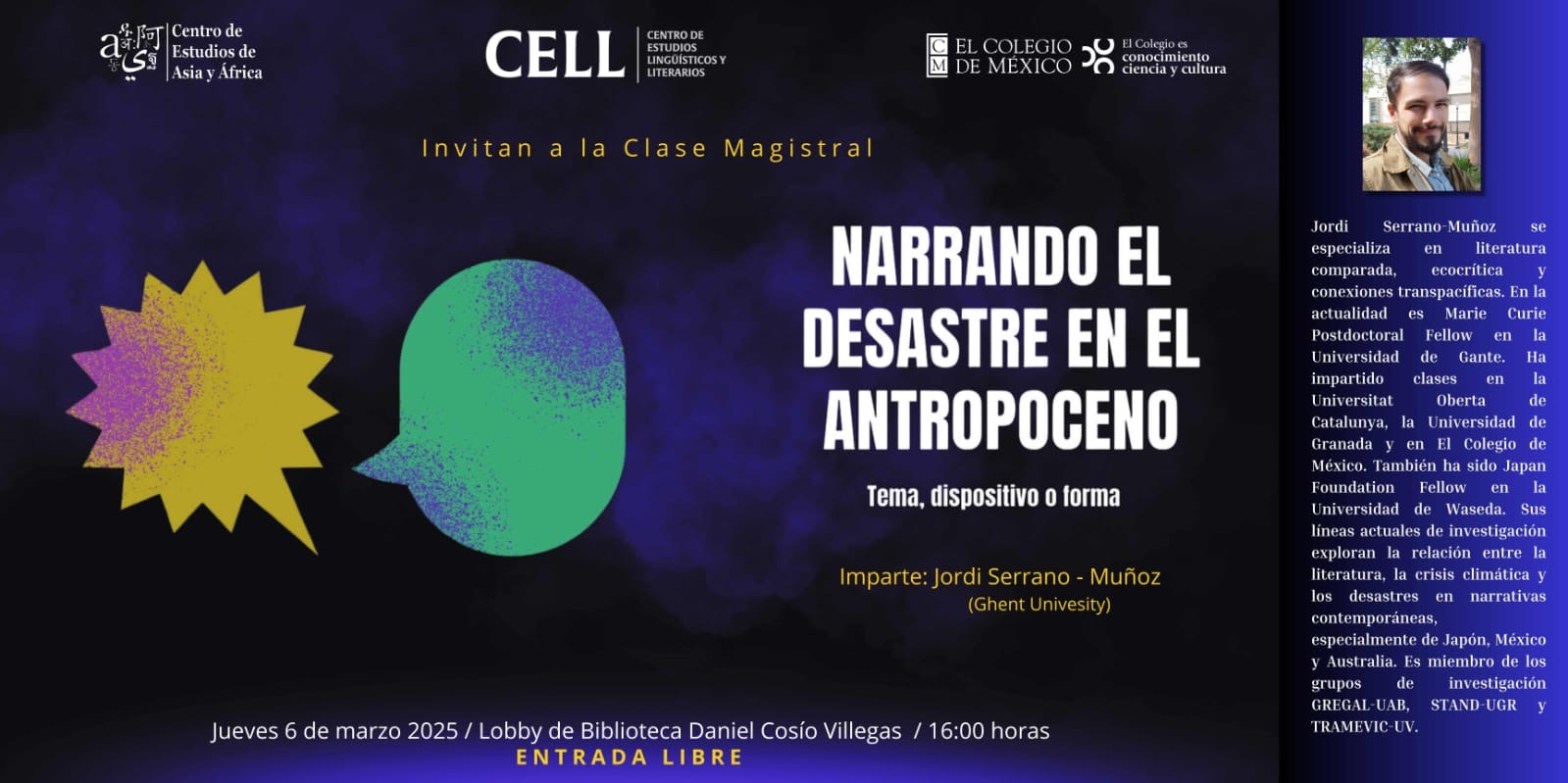
More importantly, I was invited to conduct a master class on Disaster Narratives in the Anthropocene, which was a fantastic opportunity to put to a test my current work and bring home interesting thought-provoking comments from the very active audience.

My special thanks too to professor Matías Chiappe for extending the invitation to work with you and the rest of our colleagues at El Colegio de México and for acting as a gracious host throughout my stay.

Conference Paper: “Wielding and Caring for the Weather: Individual Agency and Reactionary Care in Makoto Shinkai’s Tenki no Ko”

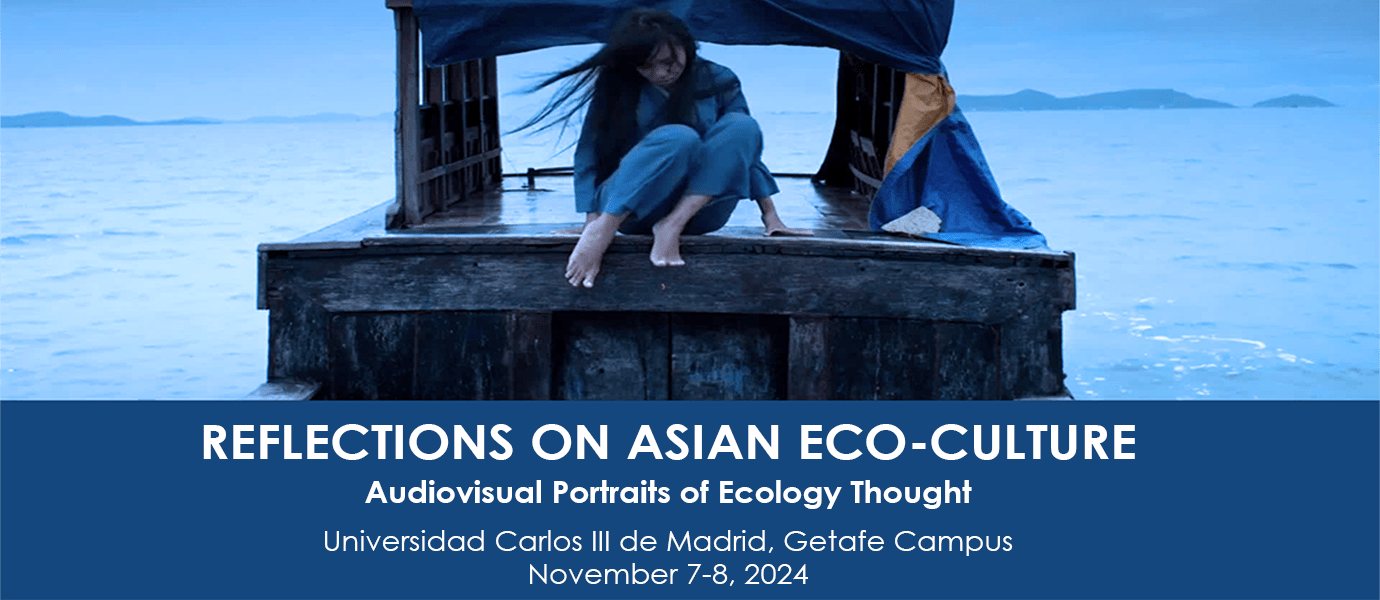
I had a great time participating in the conference Reflections on Asian Eco-Culture: Audiovisual Portraits of Ecology Thought, held at the Carlos III University, in Madrid. Being a literary scholar, it was my first time collaborating so closely with colleagues from film studies, but the thematic connections (and textual interpretations of many of the analysis) are happily strong.

I presented a paper on how Makoto Shinkai’s Weathering with You (2019) examines individual agency and interpersonal care in the face of climate crisis. While the film initially promises fresh perspectives on human-nature relationships and environmental responsibility, it ultimately retreats into conventional narrative patterns.

Kudos to the organizers, the keynote speakers (professors Ursula Heise and Sean Cubitt), and my talented panel lecturers!

CfP Theory Now: Cli-Fi as Dystopia, Utopia, or Realism: Understanding the Challenges of Imagining the Climate Crisis

I am editing a special issue on Cli-Fi for the journal Theory Now, to be published in summer 2025. Here are the details:

Submissions until December 1, 2024. Please ensure that submissions are sent to the guest editor (jordi@serranomunoz.com) and uploaded simultaneously to the platform.

In a time when the specter of environmental catastrophe is not a possibility for a hypothetical or distant future, but a matter of contemporary and most pressing concern, the ways in which we incorporate its causes and consequences into our collective cultural imagination as a species has emerged as a dynamic arena for critical inquiry. As scientists, scholars, and policy-makers grapple with the complexities of how to effectively address the climate crisis, contemporary fiction has become a site for exploring another set of parallel questions: how are we imagining a present and a future where climate crisis is the new norm? When do we cross the threshold of considering the ongoing climate crisis a matter of realist fiction instead of a concern for authors of dystopian plots? Is it still possible – or even responsible – to imagine eco-utopias based on how far behind are we on our goals for sustainable development? Or are they now more necessary than ever to promote an ideal objective to achieve?

Building upon existing scholarship, this special issue of Theory Now aims to deepen our understanding of climate fiction (cli-fi) and to question the range and diversity of its manifestations. From the stark realism of cli-fi dystopias to techno-optimism, authors employ a diverse array of narrative techniques to confront the existential challenges posed by the climate crisis. We encourage authors to analyze the intricate interplay of form and content, exploring how fiction shapes our understanding of the climate crisis and inspire transformative action. As our definition of what to consider cli-fi continues to evolve as a genre, questions surrounding its boundaries, conventions, and aesthetic sensibilities have come to the fore.

While much attention has been paid to cli-fi produced in Europe and the United States, voices from the Global South offer invaluable perspectives on the climate crisis, challenging dominant narratives and foregrounding the intersecting dynamics of race, class, and colonial legacies. We encourage papers addressing these questions and which explore the diverse voices and narratives emanating from underrepresented connections and traditions.

We welcome submissions from scholars across disciplines, including literature, cultural studies, environmental humanities, and beyond. Interdisciplinary approaches are encouraged, as are contributions that engage with underrepresented voices and perspectives. An example of potential topics includes, but is not limited to:

  • Discussion on the state and direction of speculative fiction, either utopias or dystopias, when it comes to the representation of the climate crisis.
  • Debates over how tropes associated with cli-fi intertwined with conventions traditionally associated with realism in literary fiction.
  • Contemporary fictional representations of the climate crisis, specially by authors from the Global South.
  • The role and presence of counter-hegemonic politics of care and ecofeminism in contemporary climate fiction.
  • Challenges for the narration of the climate crisis, such as questions on temporality, spatial distribution, regional inequality, individual vs collective agency, or human-nonhuman relationships.
  • Transmedia and transdiciplinary approaches to the representation of the climate crisis, with an emphasis on the challenges and opportunities brought by bending traditional conventional lines.

Papers should be between 5,000 to 11,000 words, including notes and references. They need to follow the journal’s style of conventions and can be written in English, Spanish, or French. Authors are responsible for any necessary language editing and proofing. Submissions must include a justification on why the author believes their paper fits within the scope of this special issue.
Participation in the Conference “The Global Novel: Material Objects and Forms”

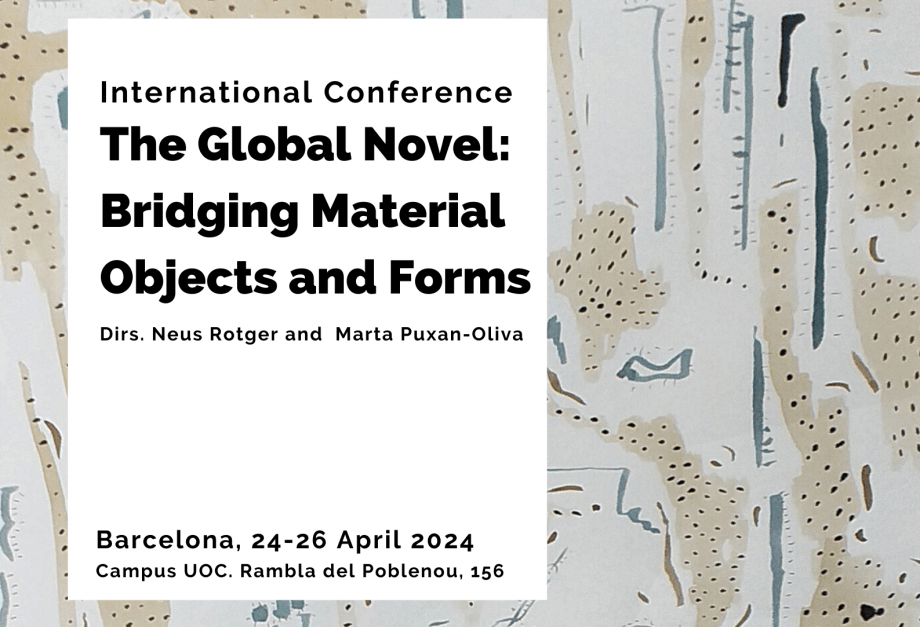
It was my great pleasure to participate on April 25 in the international conference The Global Novel: Material Objects and Forms, the closing event for the ERC project The Global Novel, led by Neus Rotger, with my paper “Care, Nature, and Dystopia: Affective Ecocriticism of Tawada Yōko’s Kentōshi and Fernanda Trías’ Mugre Rosa“.

It was a wonderful event filled with very interesting presentations and a lively discussion on the limits and challenges for current debates surrounding what we call global literature.

Actividades de febrero 2024: catástrofes y distopías en México

Este febrero, aprovechando un viaje a México, he tenido el gusto de poder participar en dos actividades organizadas en la capital.

Por un lado, el 15 de febrero fui invitado a participar en un coloquio sobre el pensamiento traumático en las distopías transpacíficas organizado por el Centro Cultural Hotaru, una iniciativa incipiente de divulgación de conocimiento sobre Japón.

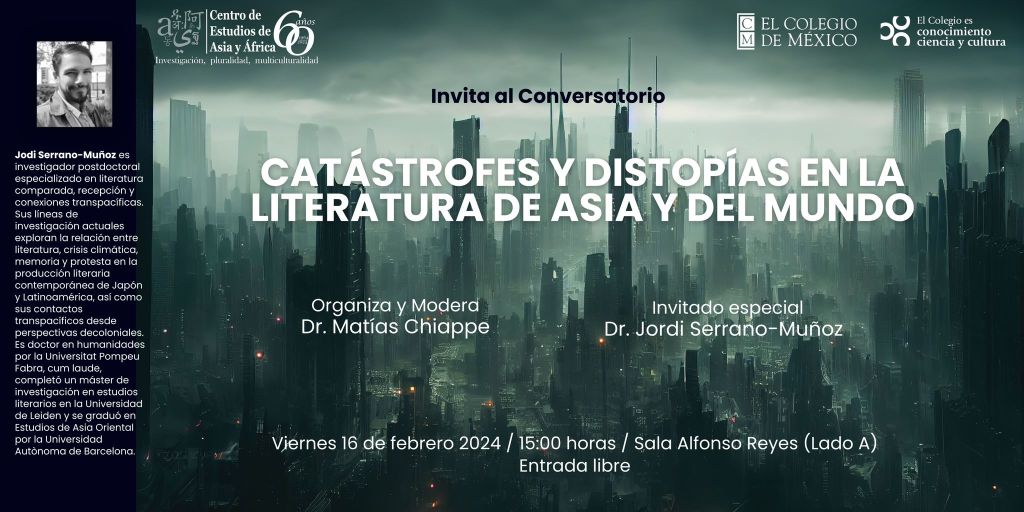
Por otro, al día siguiente, 16 de febrero, regresé felizmente al CEAA para dar esta charla junto con mi amigo y colega Matías Chiappe sobre cómo se construye contemporáneamente la idea de catástrofe y distopía desde la ficción asiática.

¡Muy agradecido al público y a los organizadores por todo vuestro interés!

Cursos abiertos de otoño 2023 de introducción a la literatura y cultura japonesa contemporáneas

Este otoño he tenido el gran gusto de poder impartir dos seminarios muy enriquecedores a nivel profesional, pero también personal, porque no iban dirigidos exclusivamente a la comunidad académica universitaria (¡siempre va bien salir del nicho!).

En “Introducción a la cultura japonesa: una aproximación comparativa”, impartido en el CTIF-Centro de Madrid, hicimos un curso acelerado pero en profundidad de aspectos históricos, políticos y culturales de Japón, con un énfasis en la desexotización del país, pensado para profesores de instituto de la Comunidad de Madrid. Fue una experiencia muy grata en la que pude disfrutar también del conocimiento e intereses de un público tan diverso. Enseñar a educadores siempre es un reto, además.

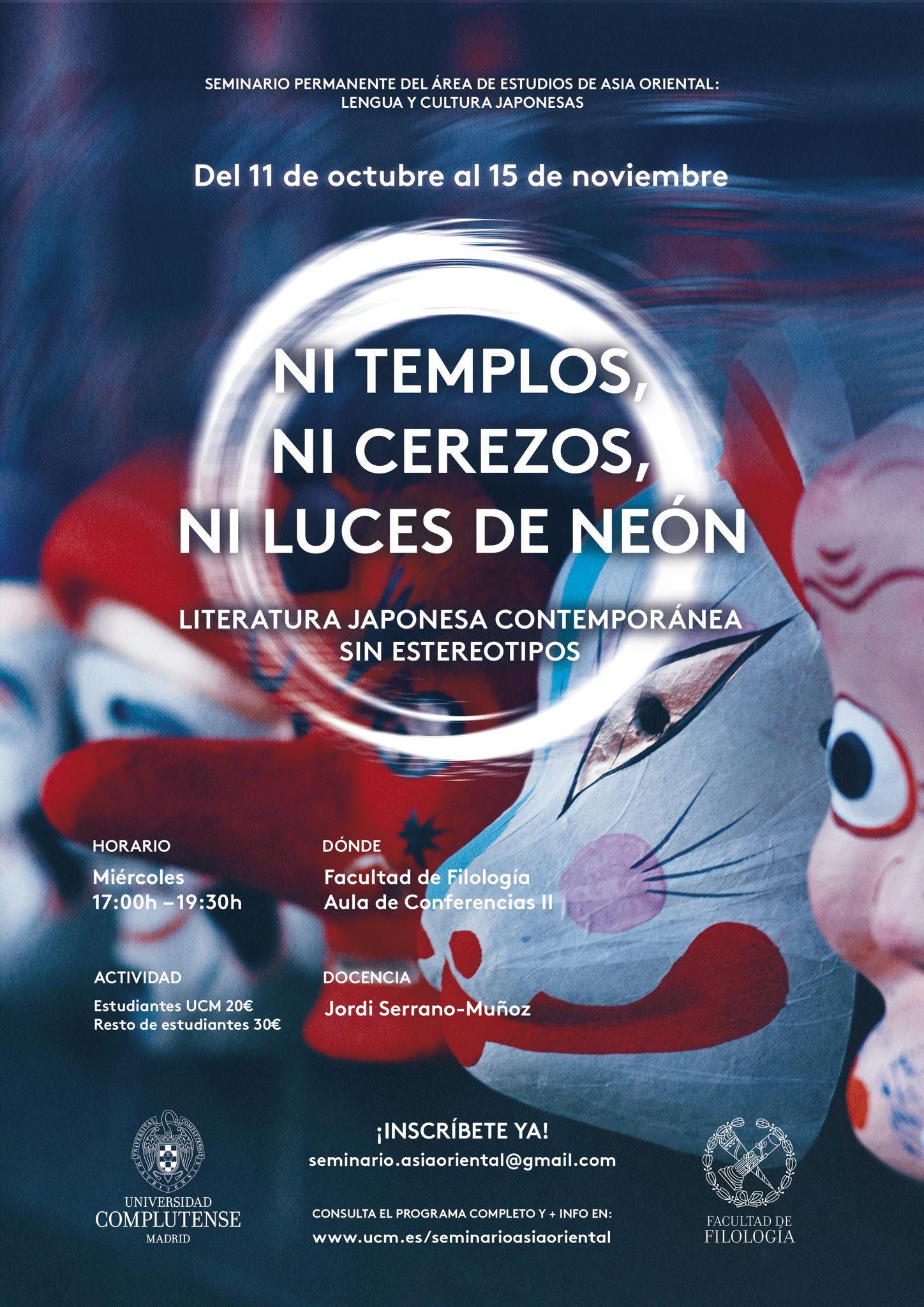
“Ni templos, ni cerezos, ni luces de neón: la literatura japonesa contemporánea sin estereotipos” ha sido un seminario en línea organizado por la Complutense de Madrid en el que hemos visto, por bloques, varios de los conflictos y autores principales de la producción literaria japonesa, presentado para un público abierto (desde estudiantes de la UCM hasta asistentes de todas partes) que se acercara con o sin conocimientos de la misma. Agradezco el interés de todos los participantes; sé que se quedó un poco corto, a la próxima lo haremos más largo.

Muchas gracias al CTIF y a la UCM por su gran trabajo de organización. ¡A por más ediciones!