Melbourne research stay

The third and last research stay of the year, the one that closed the circle opened in February in Mexico and followed in June in Tokyo, brought me to Melbourne at the invitation of Debjani Ganguly and Killian Quigley from the Institute of Humanities at ACU. I spent the month of October happily shifting between endless coffee dates with researchers at the Institute and at the University of Melbourne, doing book hunting, getting elbows-deep in writing, and walking around the now quite dear areas of Fitzroy, Collingwood, and the solace of the Yarra river.

There was time too to add a short trip to Sydney to attend Marco Caracciolo’s lecture at the University of New South Wales on Weird Ecologies in Literature and Video Game Narratives. We enjoyed the hospitality of Paul Dawson, Sean Pryor, Xanthe Muston, and Shaye Easton, among other friends and colleagues. There was even time to make some sightseeing across the coast, bracing the strong spring winds.

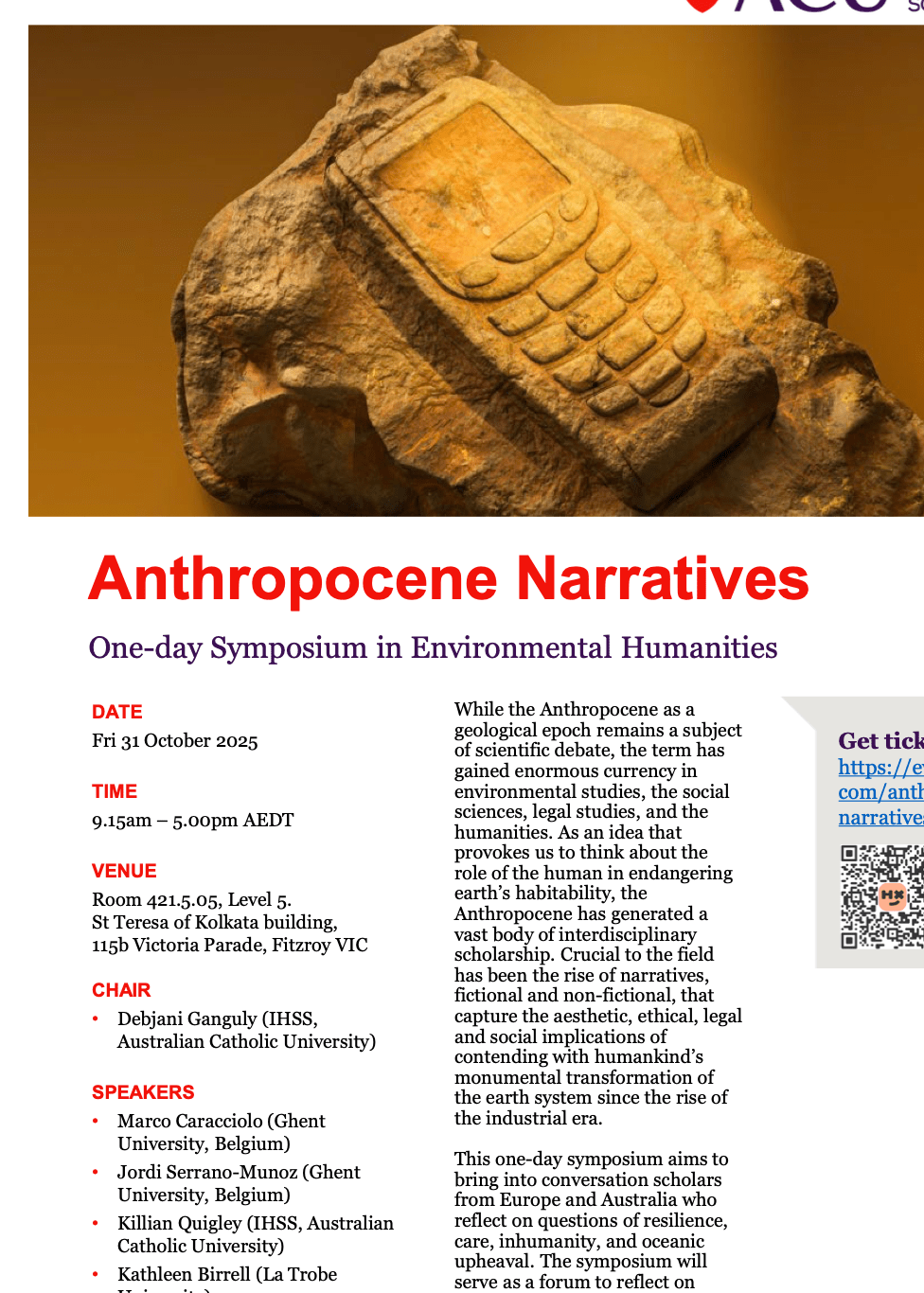
The stay had its climatic peak with a full-day event at ACU on Anthropocene Narratives. Together with the wonderful presentations by Marco, Killian, and Kathleen Birrell, and expertly chaired by Debjani, we discussed questions of time, materiality, action, and the convergence of human and nonhuman interests in narrative. I thank the opportunity also of sharing my ongoing work on the thematic and formal narrative conditions of disaster distortion as it applies to the imagination of care, which has been my main theoretical development during this stay.

Summer activities 2025

This has been a very prolific and exciting summer, which started at the end of Spring and has been filled with different public activities: workshops, conferences, and symposia.

As mentioned in the previous post, in May I joined Chiara Xausa and Marco Caracciolo for a workshop at Ghent University on ecofeminism, as part of the wonderful ongoing series of ecocritical reading sessions organized by Shannon Lambert and Leila Williamson. I talked about reactionary care in Makoto Shinkai’s Weathering with you – a paper will come out soon if all goes well!

Later on, I participated in the TRAMEVIC symposium, organized at the University of Valencia by Marcos Centeno, on visual representations of transnational memories, specifically in a session on the redefinition of perpetrators, with a paper on the greenwashing and whitewashing of Japan’s wartime responsibility in Godzilla Minus One.

June was devoted to a research visit to Japan. It started with my attendance at the Japan Past and Present conference on the reimagination of the field of Japanese studies, held at my dear temporary alma mater, University of Waseda. I then took the chance to stay longer in Tokyo and gather material, resources, meet with friends and colleagues, and buy books, many books. I was also invited by UGent’s EU-team to give a talk to prospective MSCA candidates, providing advice on what could they do to enhance their chances of succes.

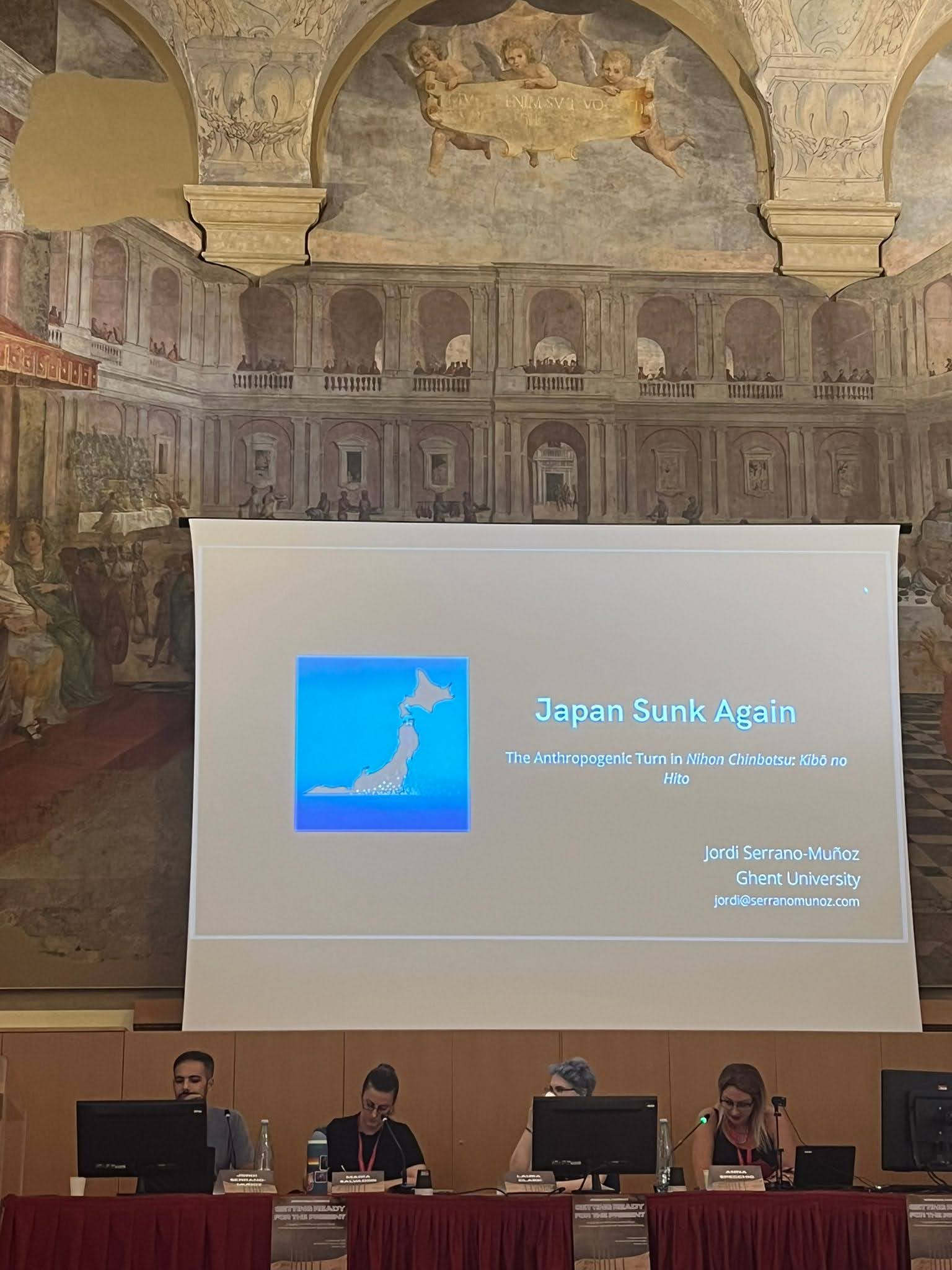
Finally, I am happy to have participated in the conference “Getting Ready for the Present: Engaging with the World and the Planet in Contemporary Dystopian and Speculative Narratives”, organized at the University of Bologna, at the stunning San Giovanni in Monte complex. I presented a paper on the Anthropogenic turn as traced by analyzing the adaptation of Komatsu Sakyo’s seminal Japan Sinks in Japan Sinks: People of Hope. I don’t think I have ever had a better background for these kinds of talks! My sincere gratitude to the organizers, the team led by prof. Paola Scrolavezza.

Ecofeminist panel at Ghent University Spring 2025

Springtime 2025 in Ghent has been marked by a lot of emphasis on setting up the analytical framework of the project, testing the methodological setup of thematic comparative analysis through empirical stress-testing and some valuable help from my colleagues at the department, and preparing some texts on these initial outcomes, hopefully to be published once they go through the necessary stages of internal (and external) review.

I also had the wonderful chance to discuss questions on ecofeminist analysis of literary works together with my colleagues Marco Caracciolo and Chiara Xausa in a panel organized by Shannon Lambert and Leila Wilson as part of their fantastic ongoing working group on ecocriticism. While Marco discussed matters on care and queering for the nonhuman and Chiara did a wonderful job in laying out the grounds and definitions of the discipline through her case studies, I decided to talk about how ecofeminist concerns can emerge also as a way to reveal reactionary motives in works that otherwise would have been overlooked. I used the case of Tenki no ko, or Weathering with you, by Makoto Shinkai, to show how the romantic love relationship that structures this disaster narrative can be seen as reactionary when read through an ecofeminist lens.

A written version of these arguments will – hopefully – be available soon in publication.

Research stay in Mexico Winter 2025

Going back to Mexico, at this point, is always a treat. Not only did I have the chance of seeing old friends and acquaintances, walking the lovely yet unevenly paved streets, and struggle against my role in the gentrification of the city, but also it was a wonderful and productive experience for my project. I socialized my ideas, received interesting feedback, and came back with new books in my suitcase.

I had a chance of discussing during a graduate workshop the spaces of connection and tension between discourses of modernization and the role of disasters in Japan during the first half of the twentieth century, creating parallels with the function catastrophes have had for Mexico.

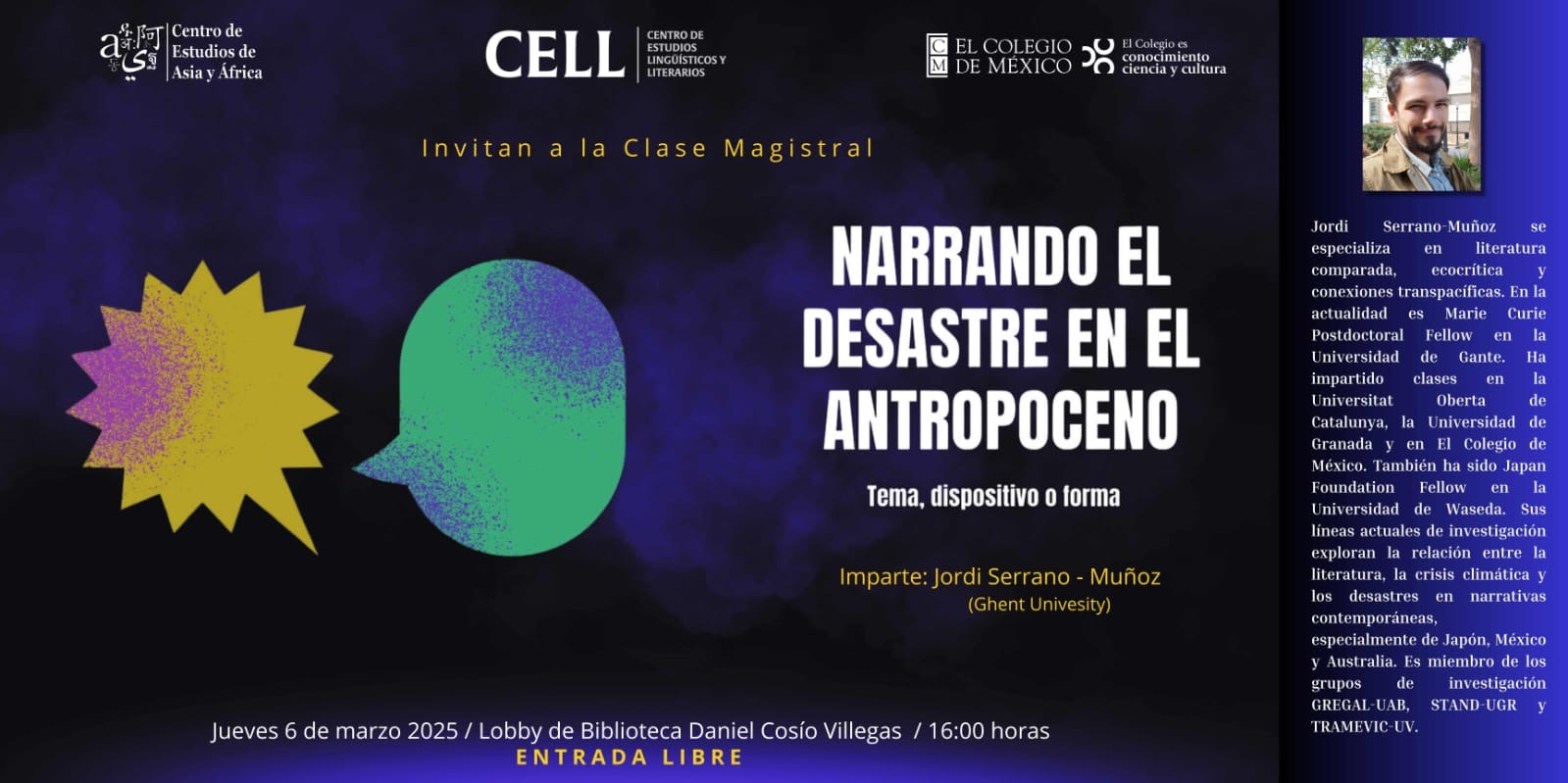
More importantly, I was invited to conduct a master class on Disaster Narratives in the Anthropocene, which was a fantastic opportunity to put to a test my current work and bring home interesting thought-provoking comments from the very active audience.

My special thanks too to professor Matías Chiappe for extending the invitation to work with you and the rest of our colleagues at El Colegio de México and for acting as a gracious host throughout my stay.

Conference Paper: “Wielding and Caring for the Weather: Individual Agency and Reactionary Care in Makoto Shinkai’s Tenki no Ko”

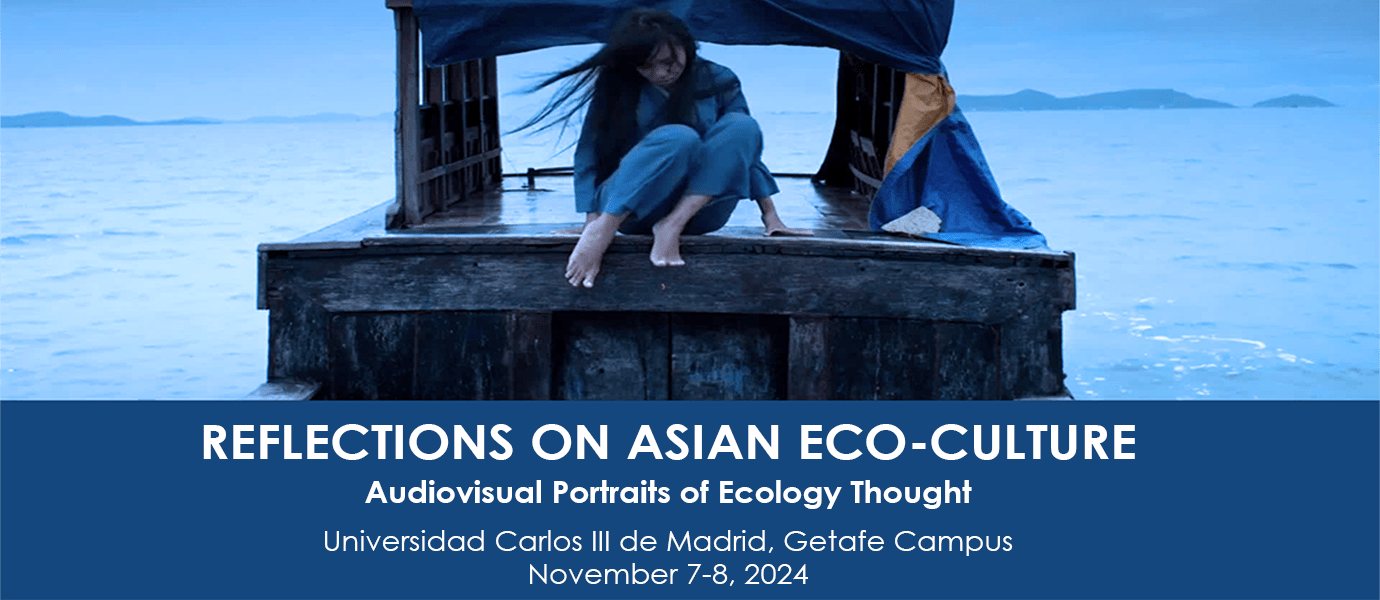
I had a great time participating in the conference Reflections on Asian Eco-Culture: Audiovisual Portraits of Ecology Thought, held at the Carlos III University, in Madrid. Being a literary scholar, it was my first time collaborating so closely with colleagues from film studies, but the thematic connections (and textual interpretations of many of the analysis) are happily strong.

I presented a paper on how Makoto Shinkai’s Weathering with You (2019) examines individual agency and interpersonal care in the face of climate crisis. While the film initially promises fresh perspectives on human-nature relationships and environmental responsibility, it ultimately retreats into conventional narrative patterns.

Kudos to the organizers, the keynote speakers (professors Ursula Heise and Sean Cubitt), and my talented panel lecturers!